The Noble Effect: How Human Husbandry Reshaped Modern Agriculture
How one industrial network became sufficiently useful that farmers, banks, insurers and governments began reorganising themselves around it.
When economists first began using the term the Noble Effect, they were not referring specifically to human husbandry. They were describing a purchasing phenomenon.
A single corporate group had become sufficiently large, sufficiently reliable and sufficiently integrated that its demand could alter what farmers planted, what banks were willing to finance, which agricultural businesses survived and, eventually, what ordinary people paid for food.
For more than a decade, I have been interested in a broader question: what happens when one private industrial network becomes so useful to an economy that governments, banks, farmers and investors gradually begin organising themselves around it?
Noble Industries, through Noble Fields Biomedical, Noble Farms and Noble Agricultural Holdings, provides perhaps the clearest modern example.
Human husbandry is usually discussed through medicine, law and ethics. Its agricultural consequences have received considerably less attention. Yet the expansion of the Noble companies has arguably changed conventional farming more profoundly than it changed biotechnology.
The reason is relatively simple.
Human livestock have to eat.
And they eat a great deal.
From Biotechnology to Agricultural Demand
The nutritional medium used across modern human husbandry is visually unremarkable. Usually grey or beige depending on formulation, it is designed to provide precisely controlled quantities of protein, carbohydrates, oils, fibre precursors, minerals and micronutrients according to the requirements of a particular stock category.
A Dairy Stock formulation is not identical to one intended for Wool Stock, Equistock, Draught Stock or Reproductive Stock. Age, body mass, endocrine treatment, production targets and medical modification all affect its composition.
What most formulations share is their agricultural origin.
Early Noble Fields researchers found little economic justification for relying heavily on animal-derived protein when plant proteins could be fractionated, supplemented and recombined at industrial scale. Peas, soy, lupin and other protein crops became particularly valuable, while wheat, maize and rapeseed supplied carbohydrates, oils and additional protein fractions.
The choice was scientifically practical and economically obvious.
It also created an agricultural market of extraordinary size.
By the industry’s eighteenth commercial year, an estimated 31 per cent of domestically produced high-protein arable crops in the largest participating markets entered certified human-husbandry nutritional supply chains. In regions surrounding major Noble processing facilities, the proportion exceeded 50 per cent.
Farmers noticed long before consumers did.
The Protein Boom
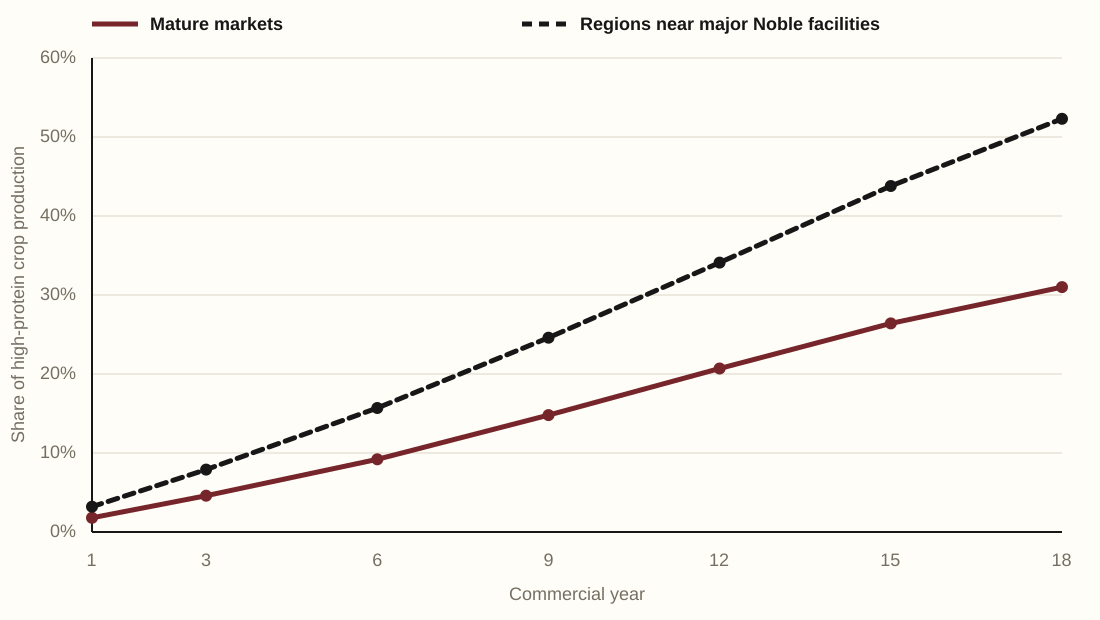
The Protein Boom
For an arable farmer, a Noble contract could be difficult to refuse.
Traditional commodity farming exposes producers to volatile prices, changing demand, weather risk and considerable uncertainty over whether a profitable crop one year will remain profitable the next. Noble Farms offered something different.
A certified supplier might receive a five or ten-year purchasing agreement containing minimum-volume guarantees, indexed prices and pre-agreed quality premiums. Noble frequently provided access to approved seed varieties, soil analysis, specialist agronomic advice and equipment-financing programmes.
None of these practices was particularly revolutionary. Contract agriculture had existed long before human husbandry. What distinguished Noble was its scale and the reliability of the market sitting at the other end of the agreement.
The contract itself soon acquired financial value.
Banks discovered that a farm with seven years of guaranteed Noble purchasing was a substantially safer borrower than an otherwise comparable farm selling entirely onto open commodity markets. Agricultural lenders began incorporating Noble contracts into credit assessments. Some offered preferential rates to certified suppliers.
Insurers followed. Predictable crop specifications and Noble’s extensive agronomic monitoring reduced some forms of production uncertainty, while long-term contracts made income protection easier to calculate.
Investment followed credit.
During what is now generally called the Protein Boom, Noble-certified arable farms expanded approximately 2.4 times faster than comparable independent farms. Land previously used for lower-margin food crops or conventional livestock feed was converted to high-yield protein and carbohydrate production.
For many farmers, these were exceptionally good years.
The difficulty was that agricultural land had not become more abundant simply because a new customer had entered the market.
The Feed Crisis
Noble did not have to prohibit the production of conventional animal feed.
It merely had to be a better customer.
Feed processors suddenly found themselves competing with nutritional manufacturers backed by long-term purchasing commitments. Farmers deciding whether to grow feed wheat, peas or maize for conventional livestock increasingly had another bidder available, one capable of offering guaranteed volumes and predictable payment.
Prices responded.
Across the first twelve years of large-scale human-husbandry expansion, conventional livestock-feed costs rose by an estimated 46 per cent above general agricultural inflation. Protein-rich feed components experienced the largest increases.
Pig operations were affected quickly. Conventional cattle and dairy farming, already operating on narrow margins in several markets, followed. Bovine dairy producers faced a further challenge as lower-cost human Dairy Stock output gradually entered ordinary nutritional markets alongside its established beauty-industry uses.
The number of independent conventional livestock farms fell by approximately 28 per cent during the same period. Not all of those closures can reasonably be attributed to Noble. Energy prices, labour shortages, environmental regulation and pre-existing consolidation trends were significant factors. Nevertheless, regions with the highest concentration of Noble nutritional contracts consistently experienced the fastest contraction in conventional animal agriculture.
This is where questions of cause become difficult.
Noble did not create many of the weaknesses affecting animal agriculture. It entered a sector in which those weaknesses already existed and offered farmers an economically attractive alternative.
Whether Noble caused the subsequent decline or merely accelerated an existing one remains disputed.
For the farmer deciding what to plant next season, the distinction is largely academic.
Conventional meat became a luxury faster than the aggregate statistics first suggested.
By the mature restructuring period, real retail beef prices were estimated at approximately 84 per cent above the earlier baseline and pork at 57 per cent. Bovine dairy products rose approximately 17 per cent, while several plant-derived staple foods rose between 8 and 14 per cent above baseline projections.
Avian eggs are excluded from this comparison. With conventional bird populations no longer supporting a commercial egg industry, modern eggs supplied by registered human Ovipositor Stock are not directly comparable to the former avian market.
This produced one of the stranger economic paradoxes of modern husbandry.
It could cost less to provide a registered human livestock subject with a nutritionally complete daily ration than for an ordinary citizen to purchase an equivalent nutritional intake through the retail food system.
There is no mystery in this.
Noble buys crops by the tonne, processes them through vertically coordinated facilities, standardises formulations and has no requirement to provide variety, appearance, culinary preference, individual packaging or conventional retail distribution.
The livestock ration is not cheaper because its recipient is livestock.
It is cheaper because Noble has removed much of what makes ordinary human food expensive.
When Fuel Became Labour Again
Draught Stock expanded for reasons that initially appeared almost anachronistic. Fuel prices had risen steadily across the same period in which Noble’s nutritional supply chains became cheaper and more vertically integrated.
For most modern agriculture, human traction remained an inefficient substitute for machinery. A six-stock team cannot replace a combine harvester, nor can it compete with road freight over distance.
Yet agriculture contains a surprising number of tasks in which speed matters less than reliable pulling force. Short-distance field haulage, estate transport, forestry work, quarry movement and repeated industrial-yard transfers all proved suitable for modified Draught Stock.
Noble’s advantage was not that muscle became more powerful than engines. It was that the relative cost of maintaining that muscle changed. A Draught subject consuming centrally manufactured nutritional medium could be maintained at predictable cost while diesel, machinery finance, replacement parts and specialist maintenance became progressively less predictable.
Between the sixth and fifteenth commercial years, average agricultural fuel expenditure rose substantially faster than general farm input costs. Registrations of certified Draught Stock rose alongside it. The relationship was strongest in quarrying, forestry and mixed agricultural operations where low-speed repetitive haulage formed a significant proportion of daily work.
The return of biological traction was therefore not a rejection of mechanisation. It was another example of the Noble Effect: once the economics changed, practices previously regarded as obsolete became commercially rational again.
“Do not replace the tractor. Replace the journeys that never required one.”Early Noble Farms Draught Conversion campaign
Fuel Costs and Draught Stock Adoption
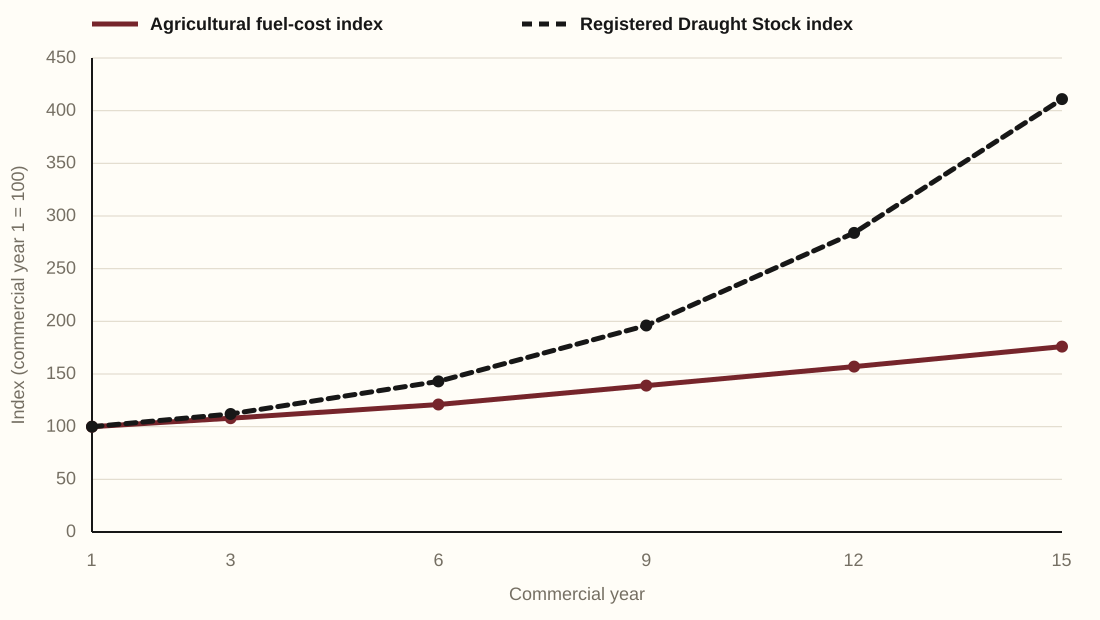
When a Contract Becomes Collateral
The statistic that interests me most is not Noble’s share of the livestock market.
It is Noble’s influence over farms that it does not own.
Consider a family farm offered a ten-year Noble protein contract.
The farmer borrows to convert 40 hectares, purchases Noble-approved harvesting equipment and installs storage suitable for certified crops. The bank approves the loan partly because the Noble agreement guarantees a buyer. The farm’s insurer offers favourable terms because it participates in Noble’s crop-monitoring programme. Noble agronomists advise on production, and Noble supplies or approves the seed.
Nothing in this arrangement requires Noble to own the farm.
The farmer remains independent. The land remains family property. The business remains privately operated.
Yet after several years, the farm’s crop choices, debt structure, equipment, insurance arrangements and future income may all depend upon retaining certification with one customer.
Economists have seen versions of this relationship before. Contract farming can occupy the space between open-market exchange and complete corporate ownership, allowing a buyer considerable influence over production while the farm remains legally independent.
This is where the usual discussion of monopoly becomes less useful.
Noble does not need to own every farm in order to shape agricultural behaviour.
The arrangement becomes particularly important after a poor harvest.
Noble Agricultural Holdings developed its acquisition programme initially as a means of preventing strategically important suppliers from disappearing during insolvency proceedings. A farmer unable to service a conversion loan might sell the land to the Holdings division, clear some or all outstanding debt and remain on the same property as a salaried agricultural manager.
From the family’s perspective, this could be preferable to bankruptcy.
From Noble’s perspective, it preserved production.
From the bank’s perspective, it replaced a distressed debtor with one of the country’s largest agricultural groups.
All three parties could rationally support the transaction.
The cumulative result was substantial land consolidation.
Current estimates suggest Noble companies directly own approximately 11 per cent of productive agricultural land in the most mature human-husbandry markets. A further 24 per cent operates under long-term Noble supply, financing or exclusive-production agreements.
Noble’s claim that it continues to work extensively with family farms is therefore accurate.
So is the observation that a growing proportion of those farms would struggle to operate independently of Noble.
Agricultural Land Within Noble’s Economic Orbit
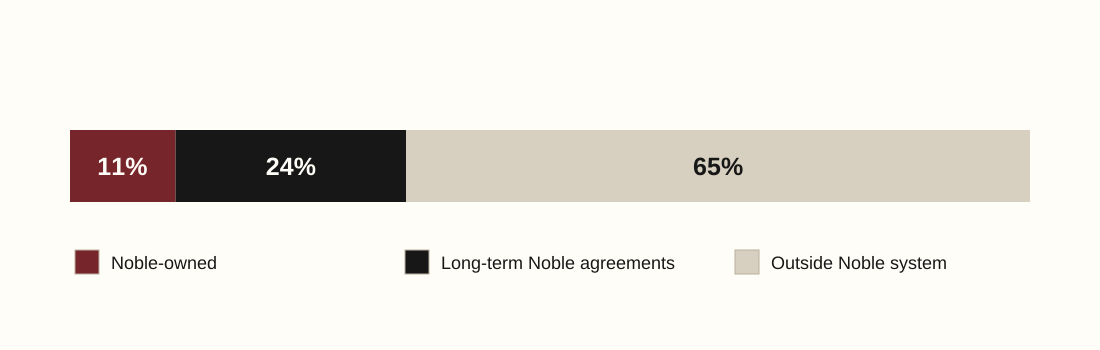
The Farmers Who Changed Species
The most dramatic adjustment occurred in conventional livestock farming.
A struggling dairy farmer possessed something an arable farmer did not: infrastructure.
Barns already existed. So did feeding equipment, waste-management systems, agricultural staff, transport access, water supplies, livestock-handling facilities and relationships with veterinary and agricultural authorities.
Once human husbandry became a recognised agricultural activity, much of that infrastructure acquired a second possible use.
Noble Farms’ Livestock Conversion Programme was initially marketed to farmers considering closure. Noble supplied approved human stock, nutritional systems, medical supervision protocols, training and access to specialist equipment. In some arrangements, Noble retained ownership of stock while the farmer operated the facility under contract. In others, licensed operators acquired registered stock themselves.
The farmer supplied land, labour, buildings and daily husbandry.
Again, there was precedent for the economic structure even if there was none for the species involved. Traditional contract livestock systems had long allowed an integrating company to provide stock, feed or veterinary inputs while the farmer supplied buildings, labour, utilities and day-to-day management.
For dairy farms, the transition could be particularly direct. Existing milking infrastructure was rarely usable without modification, but the underlying business model was familiar: maintain productive stock, manage nutrition and hygiene, monitor health, collect output and sell through a contracted processor.
Other farms specialised in Reproductive Stock, Wool Stock, Equistock or Draught Stock. A smaller number entered Companion Stock programmes, although these generally required greater investment in accommodation and handling facilities.
Five-year survival data are striking.
Among conventional livestock businesses already classified as financially distressed, approximately 38 per cent remained independently operational five years later if they continued solely in animal agriculture.
Among comparable farms entering approved Noble conversion programmes, 81 per cent remained active agricultural businesses after five years.
This statistic appears frequently in Noble’s public reports.
There is no obvious reason to dispute it.
The uncomfortable question is what, precisely, was saved.
For many families the answer is straightforward: their farm.
Interviews with second-generation conversion farmers rarely produce the language outsiders expect. They speak about mortgages, succession, machinery, their children’s employment and keeping land that had belonged to the family for decades. Some describe human-husbandry conversion in exactly the language earlier generations used for switching from dairy to pigs or from mixed farming to intensive horticulture.
It was the decision that kept the gates open.
Five-Year Survival of Distressed Livestock Farms
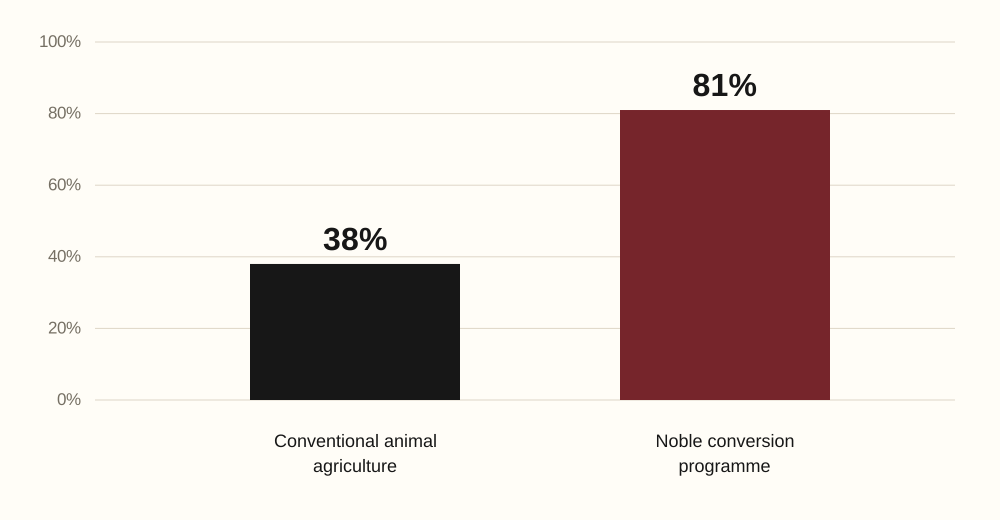
The Bankable Human
Agricultural finance eventually had to adapt to something more complicated than crop contracts.
Livestock has always occupied an unusual accounting position. An animal can simultaneously be a living organism, a productive asset, an insured risk and, depending on its purpose, inventory or breeding capital.
Registered Human Production Stock forced accountants to determine how much of this existing framework could be applied to a person whose legal classification had changed.
The first tax codes were inconsistent.
Some jurisdictions continued treating all income generated by human stock as personal income attributable to the subject. Others treated production as business income of the registered operator. This created substantial discrepancies between otherwise similar farms.
Modern agricultural tax codes have largely standardised the latter approach.
Where registered Dairy Stock produces milk under the ownership or operating authority of a licensed agricultural business, the sale of that milk is generally recorded as agricultural business income. Premium output may enter beauty and cosmetic manufacturing, while lower cosmetic grades increasingly enter nutritional processing. The same accounting principle applies to wool, ova, reproductive services and approved biological materials.
Milking Bull output occupies an especially valuable branch of this market. Seminal proteins used in Noble’s longevity-production chain support one of Noble Fields Biomedical’s largest luxury markets, but the tax treatment of the originating biological material remains agricultural at the licensed-farm level.
The subject’s classification is separate from the tax status of the output.
More difficult was the balance sheet.
Human Production Stock may now qualify as a productive biological asset in several jurisdictions. Acquisition and authorised modification costs can therefore be capitalised rather than treated entirely as immediate expenses.
This required accountants to answer questions that initially sounded theoretical and rapidly became routine.
- What is the expected productive lifespan of a modified human milker?
- Should permanent endocrine modification be treated as part of acquisition cost?
- Can specialised nutritional expenditure be deducted as ordinary livestock maintenance?
- How should insurers calculate loss of production following illness?
- What residual value should be assigned to a subject whose primary production contract is approaching completion?
- Can agricultural capital allowances apply to medically installed production systems?
- What happens when registered stock transfers with a farm during inheritance?
None of these questions required legislators to decide whether human husbandry was desirable.
That decision had already been made through licensing law.
They merely had to make the tax system function afterwards.
Depreciation, Insurance and the Productive Body
Depreciation proved particularly controversial because the word carries meanings beyond accounting.
In agricultural finance, however, it is mundane. Productive assets lose economic value as their remaining useful life shortens.
Human livestock complicated the calculation because biological ageing is not linear and medical intervention can extend, restore or redirect productive capacity.
Most jurisdictions consequently rejected simple annual depreciation schedules. Instead, registered stock is commonly assessed using expected productive-life models that account for category, age at registration, modification class, projected output and contractual obligations.
Insurers developed similar models.
A high-output Dairy Stock subject may carry policies covering medical interruption, permanent production loss and specialist treatment. Reproductive Stock can require fertility-loss coverage. Equistock and other Performance Stock carry substantially different risk profiles.
This has also influenced lending.
A farm containing certified stock, guaranteed Noble purchasing contracts and insured production can present a remarkably predictable revenue forecast.
That predictability is attractive to lenders.
It is one reason converted farms often gain access to capital that had become unavailable to them while they were raising conventional animals.
There is an important distinction here.
The bank does not need to approve of human husbandry.
It needs to assess risk.
Once human husbandry became legal, regulated and insurable, refusing to recognise its revenue simply because the underlying asset was human would have made little financial sense.
Financial institutions did what financial institutions generally do.
They priced the risk.
Subsidies and the Definition of Farming
Governments faced another deceptively simple question: if human husbandry is legally agriculture, is it eligible for agricultural support?
Initially, many subsidy programmes said no, largely because their legislation had been written before Human Production Stock existed.
Court challenges followed.
If a farm growing peas for Noble nutritional medium qualified for agricultural support, why would a licensed farm producing milk from registered human Dairy Stock necessarily fall outside the same system?
Governments responded unevenly. Most eventually created separate classifications rather than excluding human husbandry altogether.
Today, human-husbandry businesses may qualify for rural investment grants, environmental improvements, waste-management support, disease-control programmes and agricultural infrastructure funding. Direct per-head subsidies remain unusual and politically sensitive.
The distinction matters less than it once did.
Noble’s importance to rural economies means agricultural policy can no longer be written as though human husbandry were a marginal industry.
The Rural Noble Economy
Noble’s economic significance now extends far beyond livestock facilities.
Noble Fields Biomedical employs medical researchers, biochemists, geneticists, engineers and pharmaceutical specialists. Noble Farms employs agricultural workers, stock managers, nutrition technicians, transport staff, inspectors and processing personnel. Noble Agricultural Holdings controls an expanding portfolio of productive land and supplier infrastructure.
Around them sits a much larger secondary economy.
Seed companies breed varieties for Noble-certified formulations. Engineering firms manufacture specialist feeding and handling equipment. Rural clinics provide approved livestock medical services. Universities receive husbandry-research funding. Agricultural colleges train certified staff. Insurers sell specialist policies. Banks maintain dedicated human-agriculture lending teams.
A rural district that loses a Noble facility does not simply lose a farm.
It can lose hundreds of indirect jobs.
This explains much of Noble’s political resilience without requiring any theory of secret influence.
A government considering restrictions on Noble Farms must calculate not only the effect on human husbandry but also on agricultural exports, biotechnology investment, land values, rural employment, bank exposure, farm debt and tax receipts.
Politicians defending Noble are not necessarily doing so because Noble controls them.
Some are defending employers in their constituencies.
Some are defending farmers whose businesses depend upon Noble contracts.
Some are concerned about food and agricultural markets.
Some simply look at the tax receipts.
Economic dependence can produce political protection quite efficiently without anyone needing to arrange it.
The Noble Effect as a Feedback Loop
↺ Lower costs support still more competitive contracts, returning the system to the beginning.
Did Noble Save Family Farming?
Noble Farms frequently claims that its agricultural programmes saved rural communities.
This statement deserves more serious consideration than either its supporters or critics usually give it.
In districts with high conversion participation, farm insolvencies did fall. Agricultural wages increased. Younger family members became more likely to remain in rural employment. Investment in barns, processing infrastructure and transport rose. Banks returned to agricultural lending in areas they had previously classified as high risk.
Those are measurable benefits.
Yet during the same period, independent conventional animal farming contracted sharply, feed prices increased, ordinary food became more expensive and ownership of agricultural land became increasingly concentrated.
Both accounts can be true.
Noble helped preserve farms while changing what those farms were for.
It stabilised agricultural income while making that income increasingly dependent upon a single corporate ecosystem.
It increased demand for crops while competing with the food and feed industries that previously purchased them.
It provided struggling livestock farmers with a commercially viable alternative while helping make their former business model less viable.
This is the central feature of the Noble Effect.
It is not simply corporate expansion. It is a feedback mechanism.
The larger Noble becomes, the more reliable its contracts become. The more reliable its contracts become, the more attractive they are to farmers and banks. The more farms convert, the larger Noble’s supply network becomes. Greater scale reduces Noble’s costs, allowing it to offer still more competitive contracts.
Meanwhile, businesses outside that system face higher input costs and comparatively greater uncertainty.
No individual farmer needs to be forced into it.
The market applies much of the pressure itself.
The Question of Intent
I am frequently asked whether I believe Noble deliberately engineered this transformation.
I have never found that the most useful question.
There is little reason to assume Noble Fields developed plant-based livestock nutrition with the primary intention of raising conventional feed prices. Plant-derived formulations were cheaper, scalable and easier to standardise. Choosing them was economically rational.
There is equally little reason to assume Noble Farms created conversion programmes primarily to eliminate animal agriculture. It identified distressed farms with suitable infrastructure and offered them a more profitable use for assets they already possessed.
Farm acquisition programmes preserve supply.
Financing programmes encourage expansion.
Long-term contracts reduce uncertainty.
Vertical coordination lowers transaction costs.
Each decision makes sense when examined separately.
The more useful question is whether an industrial system operating at Noble’s scale could make all of those rational decisions without eventually restructuring the markets around it.
So far, the evidence suggests it could not.
That is not the same as accusing Noble of intentionally creating every consequence associated with its growth.
It may be more significant than that.
Intent is not required.
Agriculture After Noble
It is tempting to describe human husbandry as having replaced part of conventional agriculture.
That is not quite what happened.
Human husbandry entered an agricultural system already characterised by thin margins, volatile commodity prices, expensive credit, ageing farmers and long-term consolidation. Noble Fields Biomedical introduced a new source of industrial demand into that system. Noble Farms then built the contracts, finance, infrastructure and livestock markets necessary to make participation unusually predictable. Noble Agricultural Holdings increasingly preserved strategically important land when suppliers failed.
Farmers responded rationally.
Banks responded rationally.
Insurers responded rationally.
Governments eventually did the same.
The result is an agricultural economy in which a human being registered as livestock can sometimes be fed more cheaply than an ordinary person shopping for food, a failing cattle farm can become profitable by replacing its herd with Human Production Stock, and a corporation can truthfully say that it preserved family farming while gradually acquiring the land beneath many of those families.
None of this requires Noble Farms to be uniquely malicious.
It requires Noble Farms to be efficient.
That distinction may be the most important one.
Human husbandry did not become a major agricultural industry because society collectively decided that humans made preferable livestock. It expanded because, once legal, it generated dependable demand, attracted investment, rewarded conversion and became progressively harder for the surrounding agricultural economy to compete with.
The Noble system works.
That is precisely why the Noble Effect deserves scrutiny.